For generations, Indian kitchens have quietly run their own microbiology labs – all in the name of making the perfect bowl of curd. Whether it’s your nani’s/dadi’s (grandmother’s) steel bowl/dabba of dahi or your neighbor’s secret “never-fail” curd starter, fermented foods have always had a place at the Indian table.
Fast forward to today, and we’ve got shelves lined with probiotic curds, yogurts and tiny bottles promising big gut benefits in just a few gulps.
But here’s the catch: not all probiotics are created equal!
A closer look at milk kefir vs curd or yogurt reveals major differences in probiotic diversity, fermentation method, and real gut health impact.
Most curds, yogurts (especially store-bought ones) and commercial probiotic milk drinks, offer just one or two strains of bacteria and plenty of sugar.
Enter Milk Kefir — the microbial overachiever. This fizzy, tangy drink is fermented with kefir grains (not actual grains, but a colony of 30+ strains of bacteria and yeast living in harmony). Think of it as the Netflix crossover episode of probiotics – more diverse, more robust, and arguably, more fun than curd, yogurt, or commercial probiotic drinks; in building a healthy gut microbiome.
More importantly, with its rich probiotic diversity, kefir doesn’t just support gut health – it can help improve digestion, boost immunity, and even benefit mental health thanks to the gut-brain connection. And unlike your store-bought yogurt, it’s teeming with life – literally.
In this post, we break down how Milk Kefir stands apart from everyday curd, yogurt, and commercial probiotic drinks — and why it’s the probiotic upgrade your gut has been waiting for.
Milk Kefir vs Curd vs Yogurt vs Commercial Probiotic Milk Drinks: What’s the Real Difference?
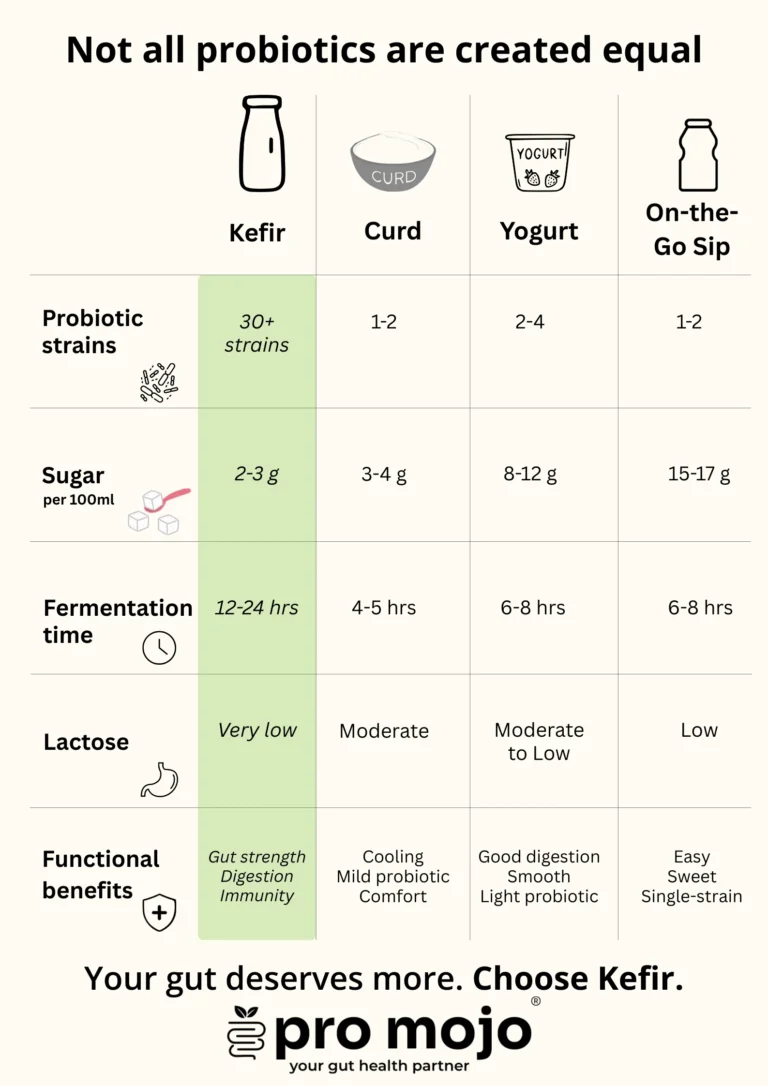
Milk kefir differs from curd and yogurt because it contains a wider range of live bacteria and beneficial yeasts. While curd and yogurt typically use a few controlled cultures, kefir is fermented using kefir grains that create a diverse, living microbial ecosystem that better supports gut health.
| Feature | Milk Kefir | Curd (Dahi) | Yogurt | Commercial Probiotic Milk Drinks* |
|---|---|---|---|---|
| Bacterial Strains | 30+ diverse bacteria & yeasts | 1-2 | 2-4 | 1–2 |
| Includes Yeast? | ✅ Yes | ❌ No | ❌ No | ❌ No |
| Probiotic Diversity | Very high | Low | Moderate | Low |
| Sugar Content | No added sugar | None added | Often added in flavoured versions | Usually high; sweetened for taste |
| Sweetener Type | None | None | Cane sugar / fruit sugar | Often refined sugar or low-calorie sweeteners (e.g. stevia) |
| Digestive Benefits | Deep gut colonization & improved microbiome | Moderate | Good | Short-term relief |
| Fermentation Type | Traditional slow fermentation | Spontaneous (natural culture) | Controlled (specific cultures) | Controlled industrial fermentation |
| Lactose Content | Very low | Moderate | Moderate to low | Low (due to fermentation) |
| Suitable for Lactose Intolerant? | ✅ Yes (most lactose broken down) | ⚠️ Sometimes (if well-fermented) | ✅ Often (check label) | ✅ Yes |
| Texture & Taste | Light tangy fizzy | Thick, set | Creamy, smooth | Thin, sweet |
| Shelf Life | Short, around 10-15 days | Short | Moderate | Long (pasteurized) |
| Additives / Preservatives | None | None | Sometimes | Often present |
| Typical Use | Functional daily probiotic – gut health immunity digestion | Meal accompaniment | Snack / breakfast, smoothies | On-the-go drink – quick probiotic shot |
Comparison based on typical preparation methods and commercially available products. *Commercial probiotic milk drinks refer to widely available, sweetened fermented milk beverages containing limited strains of bacteria.
Why probiotic diversity matters for gut health?
Your gut is home to trillions of microbes, each playing a different role in digestion, immunity, and overall health. When you consume probiotics with greater diversity, you support a wider range of these functions – rather than relying on just one or two strains to do all the work.
This is why probiotic diversity matters more than sheer numbers. A diverse mix of bacteria and beneficial yeasts helps strengthen the gut ecosystem, making digestion more efficient and the microbiome more resilient over time.
Key Takeaways
- Diversity matters: Kefir provides 30+ strains vs. just 1–2 strains in curd, yogurt or commercial probiotic drinks. More strains = stronger gut microbiome.
- Lactose-friendly: Kefir breaks down most lactose, making it easier to digest even for those who struggle with dairy.
- Functional benefits: Regular Kefir consumption supports digestion, immunity, blood sugar regulation, and even mood — making it a true daily superfood.
So, why switch to Milk Kefir?
Because your gut deserves a probiotic that actually colonizes it – not just passes through.
Milk Kefir is made the slow, traditional way, using natural kefir grains that produce a living ecosystem of beneficial microbes. No refined sugar, no additives, no shortcuts.
It’s your daily dose of natural immunity, digestion support, and real probiotic strength – straight from your fridge, not a factory line!
✨ Your Gut Deserves More.
✅ Switch to Milk Kefir – fresh, natural, probiotic-rich.
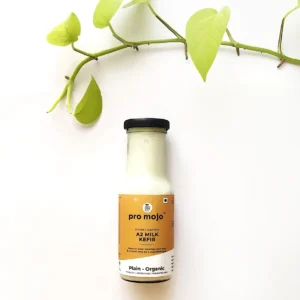
👉 Explore Milk Kefir from Pro Mojo.